Monday, March 7, 2011


I’m betting every golf course in the country, public or private, can illustrate how its 150 acres are used as green/recreational space by the community. A new attempt at outreach from the ASGCA, entitled The Value of Golf Courses: Talking Points, Talking Points (click here to download a copy) details some quite dramatic examples from across the country.


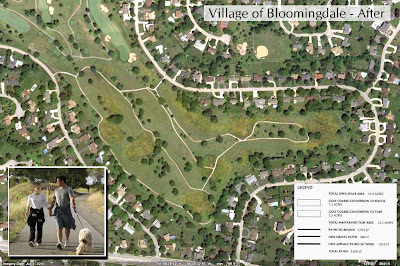
LGD actually participated in an interesting illustration of this dynamic recently. We were retained by the Village of Bloomingdale, Illinois, to help decommission 9 of 36 holes at a resort facility in town. That’s right, they paid us to take golf holes out of use. Our role was limited: covering up bunkers and devising a grassing plan that was more or less self-sustaining. But the upshot is clear: Golf courses and parklands are one and the same (we kept the cart paths as walking paths), and that land was more valuable to the community as open space than it would be as a housing subdivision — despite what the village stood to gain in terms of property taxes – which, it turns out, will still be realized in the long-term as the resort’s new Hilton-status produces additional tourism dollars for the community. A win-win, really.


We can all agree the green space benefits of golf courses, public and private, are often more wide-ranging and "everyday" — like sledding or cross-country skiing, or maybe running through the sprinklers on a hot summer night. We work with several park districts that conduct wildly popular fishing derbies using ponds on their municipal golf courses. Weigh in here with how your course serves this larger purpose. By sharing, we might gain good ideas from one another.

Wednesday, February 23, 2011

The Master Plan is Dead

The Master Plan is dead. That’s a pretty bold statement to make, isn’t it? Judging by the comments we’ve gotten already from our column in Fast and Firm (Golf Course Industry magazine’s e-newsletter), it has struck a chord with many. Most think the approach has great merit, but some are wondering if their recently completed “master plan” is now junk.

To the latter we reply, absolutely not. If we can pull our tongue out from our cheek for a moment, the killing of the master plan was a symbolic reference to the re-prioritization of the planning process. We’ve always considered cost impacts when completing renovation work of any kind. It’s just that now, these considerations are more of a driving force than an ancillary product. We feel the CBAP is a vast improvement when it comes to describing how architects and clubs need to approach renovation work today.

The major innovation of the Cost-Benefit Action Plan is its emphasis on economic efficiencies, enabled by design. Here’s an example: When we talk to a club about renovating its greens, our first priority now is spelling out exactly how much money will be saved, year over year, in maintaining the refurbished greens — in comparison to keeping the old ones. If we can show that regrassing will save a club significant $ per year, per green, in water, chemical-use and man-hours (and in most cases we can do exactly that), then we are providing the sort of renovation service clubs really need today.

Of course, the “Benefit” part of the plan does not always have to be realized in immediate dollars saved. In the process of rebuilding or regrassing greens, we might address contour or reclaiming of lost square footage around the edges or bunker positioning. We’re architects! That’s what we do! But in the context of a CBAP, these changes might be justified by their impact on, say, pace of play – which directly affects user satisfaction and return business.

If you maintain or manage a golf course, I bet you have a master plan kicking around somewhere. Maybe we developed it. How do you use it? How would you change the document to better suit the way you manage, maintain and ultimately upgrade the course? That’s what we’re asking our clients, both old and new. And we’re asking you, too.

Tuesday, December 14, 2010

As many of you know, the green fumigation-reseeding methodology will require some alternative planning in the coming years. The use of methyl bromide to sterilize greens prior to reseeding has been the subject of increased regulation for a while now. The use of methyl bromide in hot gas applications will change considerably at the end of this year. Starting Jan. 1, 2011, the product label will require increased safety precautions for applicators and reductions in allowable rates (50% or more). These restrictions alone greatly reduce the product’s viability on golf greens. In 2012, restrictive buffer zones will be added. This will effectively end the practical application on golf courses in general – except for maybe those properties located in the middle of a cornfield with no human dwellings within several thousand feet!

So, here’s a piece of advice: If you think you may need to fumigate/reseed in the next year or so... no, actually if you KNOW you want to fumigate, look into it before the end of this year. It might still be possible to sign up under the old label. If you have the product sporting that old label, you can use it on those terms indefinitely.

But suppose you don’t? What options do you have? This is an interesting question going forward, and we’re interested to hear what folks in the industry are planning. The conversation starts here.

(See article on effective project communication, including more fumigation talk, at Golf Course Industry Magazine e-newsletter)

Friday, October 22, 2010

Re-branding to Save Face


In the current golf course climate, which reflects the overall economic climate, we see among our clients a heightened interest in using design and renovation to maintain and (re)build brand/reputation. This seems especially important for public entities which rely on their golf facility to anchor their recreation portfolio. Case in point: Poplar Creek Country Club, the sole golf entity for the Hoffman Estates Park District (Illinois). The course lends itself to more than just golf, hosting banquets, weddings, fundraising events, community outreach programs and other critical Park District functions.

So any threat to this facility threatens the district itself. Therein lies the problem, the course sits in a floodplain, surrounded by development. As that development has grown thicker, any sort of rain event wreaks havoc on the course; mulitple holes can be rendered unplayable for days at a time. The result is a bad reputation and a deterent to those looking to book the course for a golfing event or a simple round with friends. Without a viable golf component, the property would quickly become an unviable operation.

Instead of waiting for that demise, the HEPD hired us to help in turning about Poplar Creek's reputation, namely by reinventing its brand. With the help of The Bruce Co., we will expand the course's water holding capacity by creating a giant system of ponds, while lifting up those fairways that previous flooded. We did largely the same thing down the road in Wheeling at the Traditions at Chevy Chase, a course that - like Poplar Creek - used to be a tired, soggy muni. That effort, combined with a host of other brand upgrades, changed the face of their golf course.

What Midwestern courses strike you as most needing this sort of brand makeover? We'd love to hear some stories about similar efforts, good or bad.
For more on the Poplar Creek story, see article in the Golf Course Industry Magazine e-newsletter.


Wednesday, September 1, 2010

Rebranding? If substantial, don't be ashamed


Design variety is important to architects. We’re always bending someone’s ear about how each of the 18 holes at a particular course are different (how we couldn’t possibly choose a favorite because they’re all so distinct!). But seriously folks, design variety should matter more to operators, especially those who manage multiple layouts.

Here’s an example from Kenosha, Wisconsin, where we will redesign/reconfigure 63 holes owned and operated by Kenosha County. Phase 1 is scheduled to break ground this spring.

When we got right down to it, the major design issue at 45-hole Brighton Dale Links was a lack of distinction between any of the five 9-hole routings there, plus the lack of a worthy practice area. Honestly: Why play there more than once or twice, why have so many holes on offer if all 45 are the same? That was the problem: Not enough people did. Our plan improves all 45 holes but creates new, higher levels of quality and challenge on 18 holes, while improving but essentially maintaining the character of 27 holes for those who liked them just the way they were.

Here design is a vital part of your marketing, in that it answers these questions: What does your course say to the golfers who play it? What does it say to the golfers who could play it, but don’t?


Tuesday, June 22, 2010

Here's a quote from Leon McNair at Links Across America (see previous post). I think he's got a point:

"There are a lot of reasons for golf's stagnant status but one reason is definitely affordability, and Links Across America is a big first step, a step forward," Leon says. "We just don't have affordability for kids and seniors. I'm a PGA member and there are a lot of programs out there, but they are primarily aimed at teaching people how to swing a club, period. That's Step 2.

"The problem is, we don't have Step 3, which is teaching people how to play golf. There are thousands of questions a new golfer has when he or she is playing golf: How to rake a bunker or why, where to stand, what to do with the pin on a green... We need someone waling around with them, or playing alongside them, so they can get answers to all those questions. When we get that piece, we'll be creating real golfers."

This is the role that dads usually play, but what do kids do when that's not an option? This is what makes golfer "creation" so difficult. You really need mentoring. Even adults who pick up the game in their 20s or 30s need a friend or colleague who performs this function.

How do we get around this?

Golf Outreach Bingo

Let's play "Golf Outreach Bingo," where we take turns naming a worthy non-profit program that grows the game. There are tons of these; every golf organization seems to have one. But how many of them really work?

Here's mine: Links Across America is part of The Wadsworth Golf Charities Foundation, philanthropic arm of Wadsworth Golf Construction. Basically, Leon McNair is head honcho and Links Across America (LAA) works with cities and park districts to identify facilities - usually short courses or nine-holers - that are worth saving and upgrading. Leon pulls in various golf industry firms, plus grassroots organizations like the First Tee and local YMCAs, to put together a plan for 1) operating these facilities independent of the municipalities; and 2) upgrading them so they can optimally serve the young and novice golfers we're targeting.

Randall Oaks West Range Teaching Facility, shown above, was our first collaboration with LAA. It will open August 2010.

Part of what makes the LAA model work is that Leon has assembled a stable of course builders, managers and architects (including Lohmann Golf Designs) who have agreed to provide services either gratis or at cost. Once the pro formas for upgrading and managing these properties are vetted, LAA and Wadsworth Golf Charities do their part by kicking in very generous grants to get these projects redesigned, built or operating. Here's how you get in touch: leonm@wadsworthgolf.com or check out the website at http://www.wadsworthgolfcharitiesfoundation.com/.


What, you have something better?