Wednesday, August 15, 2012

Realizing a long-range vision at Chenequa CC

Lohmann Companies is hard at work renovating the 2nd and 3rd holes at Chenequa CC in Hartland, WI.  Proposed as part of a long-range master plan prepared in 2002 by Lohmann Golf Designs, the project includes the construction of a new pond, complete with stone retaining wall, and the relocation of the 2nd and 3rd greens along the water's edge.  

Hole 2, a drive-able par 4, will also see the reconstruction of its fairway bunkers to add a more strategic element on the tee shot.  That, along with the new green hanging dangerously close to the water along its back edge, will give CCC members a lot more to think about when determining their playing approach on this short, but demanding hole.  Here's a look at LGD's computer rendering of the proposed green, before and after:

Hole 2 Green - Existing

Hole 2 Green - Proposed
Hole 3, an existing par 3, will essentially be a new golf hole that will play from 120 to 175 yards over the pond to a green guarded on its back and sides by new mounding and existing ravines.  The new teeing area is located along a hillside located due north of the existing tees, and offers spectacular views of this intimidating hole.  See below a before view of the new hole corridor (notice the existing green behind the trees), followed by an after view of the new hole.  These images were instrumental in getting the project approved by the members:


Hole 3 - Before from new teeing area

Hole 3 - Proposed
All of the construction work at Chenequa is being completed by Golf Creations, the golf course construction division of Lohmann Companies.  Grassing is scheduled to start in the next couple of weeks.  In the meantime, stay tuned for updates on construction and photos of our progress.      

Tuesday, August 7, 2012


The Real-World Consequences of Heat & Drought


Please take a moment to pity Jim Nedrow, the eminently capable course superintendent at the 27-hole Club at Indian Creek in Omaha, Neb. Supers are suffering all over the Midwest this summer, but this spring Jim grew in Phase II of a renovation we at Lohmann Golf Designs have undertaken at Indian Creek. The Red Feather nine opened a month ago and since the ribbons were cut, they’ve had 45 straight days without measurable rain — and temperatures for the last 30 have averaged daily highs of 99 degrees.

The pictures included here show how tough and crispy it’s been. Even where Jim has “watered in” the new grass, areas on the edge are browning out. Still, he has kept these young greens more than alive. They are healthy, rolling fast and smooth. I think Jim would tell you himself, he learned some valuable lessons from the Phase I grow-in (of the renovated Black Bird nine) — namely, he’s leaving the height of cut a bit higher on approaches and collars. This has minimized stress as they continue to mature.

Phase III construction (the Gray Hawk nine) is well underway at Indian Creek, which is one reason we were out in Omaha the first week in August, toiling in the hot, hot sun. Duininck Golf is handling construction and the dry weather — usually a contractor’s dream, in terms of productivity — has resulted in this anomalous behavior: Site superintendent Travis Quisberg is actually wetting down the construction zones! Why? To make the soil a bit more tacky and less dusty, but mainly to keep existing turf in and around those zones alive. In these hyper-hot, hyper-dry conditions, equipment and carts are doing more damage than normal. One can see the dry turf almost disintegrate under the wheels.

Omaha is a burgeoning tournament town. Indian Creek hosts its own prestigious amateur event, The Indian Creek Invitational; The Web.com Tour was at Champions Run GC last weekend; and the U.S. Senior Open visits Omaha CC next year. If you plan to attend either professional event, book yourself a tee time at nearby Indian Creek, which is about as good a daily-fee venue as you’ll find anywhere in the Midwest. Just bring a wide-brimmed hat and some sunscreen.


Tuesday, July 31, 2012


We were tickled to learn the other day that our work at The Bridges of Poplar Creek Country Club had earned 2012 Renovation of the Year honors from GolfInc. magazine. See the story here. Hats off to our clients at Hoffman Estates Park District and our colleagues at The Bruce Company of Wisconsin, who surely share equally in the gratification department.


Lohmann Golf Designs has been working with our clients in Hoffman Estates, mainly in a bunker-renovation capacity, since 1995 (so long ago, the course was then known simply as Poplar Creek GC). The course isn’t that old, opened in 1976. But it was built in a floodplain and just got soggier the more the adjacent neighborhood and commercial development expanded. When you build on and/or pave all that surrounding real estate, the water has to go somewhere. Unfortunately, much of this runoff found its way onto the golf course.


The linked story above does a good job outlining how we solved the flooding issues by expanding water-retention capability — while simultaneously improving the course (especially its risk-reward elements, thanks to all that new pond acreage). Truth is, we at LGD have experienced considerable, first-hand success both eliminating flood issues by expanding water-retention in ecologically proactive fashion — at Deerpath Golf Course in Lake Forest, IL, in 2003, for example — and better the golf experience, a the same time. In fact, the last time one of our projects earned Renovation of the Year honors, in 2005, it was The Traditions at Chevy Chase in Wheeling, Ill., where our work was again occasioned by chronic flooding issues.


It’s hard to fathom during a dry, hot summer like this one, but water-storage issues aren’t just a practical invitation to renovate. It’s more evidence that golf courses are ideally suited to perform critical municipal, communitaria functions like mitigating neighborhood flooding issues. I’d trade all our Renovation of the Year awards if conservation commissions across the country better recognized that.


Tuesday, December 20, 2011


Helping GMs & owners read between the lines

How free is a superintendent to speak his mind, really? Lohmann Golf Designs principal Bob Lohmann makes informative light of this issue in his most recent column for Golf Course Industry magazine, but it’s an interesting, important issue.


We all know that superintendents look after the most important asset at any daily-fee facility or private club: the golf course itself. But the downside to this reality is, superintendents also preside over the most expensive asset, and, on occasion, they must argue for additions to what is already the largest budget item at any course facility.


This can make communication with the head pro, the owner or board, and the golfers themselves an extremely delicate exercise. Club managers and course owners want candor, but superintendents must be extremely politic in the way they handle certain issues. Speaking their minds might just put them in a real awkward position, might put the club in an awkward position.


Bob cites three examples of on-course maintenance issues that perhaps do not get the frank discussion they truly deserve. What are the others? We at LGD are of the mind that architects can serve a valuable mediation role in situations like these — we can speak truth to power in cases where perhaps the superintendent cannot. Are there other mediators out there to whom supers can turn?


What do you think?

Monday, June 27, 2011

In February, on the pages of golfcourseindustry.com, we went public with our plans to replace the traditional master plan process with what we believe is a more efficient framework for renovation, the Cost-Benefit Action Plan. We even went so far as to say, tongue in cheek, that the master plan was dead — long live the CBAP!

The responses were great. We really touched a nerve, but in a good way.

Recently we added another component in GCI that we didn’t detail nearly enough in February: To really examine your golf course through the lens of a CBAP, you have to divide your course into cost centers: greens, tees, fairways, bunkers, drainage, etc. Then you have to ask, “Well, what’s wrong with the greens, the tees, etc.?” That leads to a consideration of what the ideal situation would be. Take greens as an example: We might be talking roll, speed, consistency (of both) from month to month, the ability to survive a hot, wet August, and so on. These are the specific standards superintendents and their owners must consider: “What do we want out of our greens. Are we achieving this? If not, why not?”

How many of you out there have taken the time to create standards for your golf course. If not, why not? We'd love to hear your stories... good, bad or otherwise.

Monday, March 7, 2011


I’m betting every golf course in the country, public or private, can illustrate how its 150 acres are used as green/recreational space by the community. A new attempt at outreach from the ASGCA, entitled The Value of Golf Courses: Talking Points, Talking Points (click here to download a copy) details some quite dramatic examples from across the country.


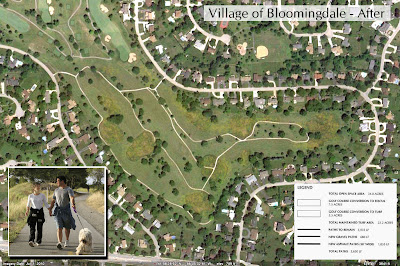
LGD actually participated in an interesting illustration of this dynamic recently. We were retained by the Village of Bloomingdale, Illinois, to help decommission 9 of 36 holes at a resort facility in town. That’s right, they paid us to take golf holes out of use. Our role was limited: covering up bunkers and devising a grassing plan that was more or less self-sustaining. But the upshot is clear: Golf courses and parklands are one and the same (we kept the cart paths as walking paths), and that land was more valuable to the community as open space than it would be as a housing subdivision — despite what the village stood to gain in terms of property taxes – which, it turns out, will still be realized in the long-term as the resort’s new Hilton-status produces additional tourism dollars for the community. A win-win, really.


We can all agree the green space benefits of golf courses, public and private, are often more wide-ranging and "everyday" — like sledding or cross-country skiing, or maybe running through the sprinklers on a hot summer night. We work with several park districts that conduct wildly popular fishing derbies using ponds on their municipal golf courses. Weigh in here with how your course serves this larger purpose. By sharing, we might gain good ideas from one another.

Wednesday, February 23, 2011

The Master Plan is Dead

The Master Plan is dead. That’s a pretty bold statement to make, isn’t it? Judging by the comments we’ve gotten already from our column in Fast and Firm (Golf Course Industry magazine’s e-newsletter), it has struck a chord with many. Most think the approach has great merit, but some are wondering if their recently completed “master plan” is now junk.

To the latter we reply, absolutely not. If we can pull our tongue out from our cheek for a moment, the killing of the master plan was a symbolic reference to the re-prioritization of the planning process. We’ve always considered cost impacts when completing renovation work of any kind. It’s just that now, these considerations are more of a driving force than an ancillary product. We feel the CBAP is a vast improvement when it comes to describing how architects and clubs need to approach renovation work today.

The major innovation of the Cost-Benefit Action Plan is its emphasis on economic efficiencies, enabled by design. Here’s an example: When we talk to a club about renovating its greens, our first priority now is spelling out exactly how much money will be saved, year over year, in maintaining the refurbished greens — in comparison to keeping the old ones. If we can show that regrassing will save a club significant $ per year, per green, in water, chemical-use and man-hours (and in most cases we can do exactly that), then we are providing the sort of renovation service clubs really need today.

Of course, the “Benefit” part of the plan does not always have to be realized in immediate dollars saved. In the process of rebuilding or regrassing greens, we might address contour or reclaiming of lost square footage around the edges or bunker positioning. We’re architects! That’s what we do! But in the context of a CBAP, these changes might be justified by their impact on, say, pace of play – which directly affects user satisfaction and return business.

If you maintain or manage a golf course, I bet you have a master plan kicking around somewhere. Maybe we developed it. How do you use it? How would you change the document to better suit the way you manage, maintain and ultimately upgrade the course? That’s what we’re asking our clients, both old and new. And we’re asking you, too.