Thursday, September 13, 2012

Golf Creations' debut as certified Better Billy Bunker installer

LORTON, Va. — Here’s a good argument for the scions of golf course architects getting out there on their own, making their own way, before eventually working for the family firm.


Matt Lohmann is a project manager here at Golf Creations, the sister construction division of Lohmann Golf Designs. He’s also the son of LGD founder Bob Lohmann. When Matt got his start in the golf business, he did so on his own — going to work as a construction superintendent for Wadsworth Golf Construction Co. Hard to beat that sort of experience.

During his tenure at Wadsworth, he oversaw construction here at Laurel Hill Golf Club. That was 2004-05, and Matt would go on to complete a couple other projects before leaving Wadsworth in 2007. But he’s back in Lorton, Va., this summer, overseeing a Golf Creations-led bunker reconstruction project in anticipation of next year’s U.S. Amateur Public Links Championship, scheduled for Laurel Hill GC July 15-20, 2013.

“I went back to Laurel Hill a number of times after it was built while doing some other work in northern Virginia, just to see how things were going and to play the course, but it’s been a few years now,” Matt explains. “It’s nice to see the course was designed and built well enough to attract a USGA championship.”

Designed by Bill Love, Laurel Hill Golf Club is indeed a beauty — situated on rolling terrain that previously housed a District of Columbia Department of Corrections facility at Lorton, whose prisoners operated a dairy farm on site. Matt Lohmann has returned with his Golf Creations colleagues to reinstall the sand in all 120 bunkers using the Better Billy Bunker method, a process Golf Creations was certified to carry out this summer.

“When we originally built these bunkers, we used a woven fabric liner,” Matt explained. “Over time, there was contamination however, and some of the fabric we used had been ripped by the sand pro. Once that fabric is ripped, it just gets worse and worse. Because Golf Creations has been certified as a Better Billy Bunker installer, we’ve been brought in to redo all 120 bunkers.”

The Better Billy Bunker method involves laying down 2 inches of gravel across the entire bunker “floor”. A spray polymer is applied; it seeps down amidst the gravel profile and hardens into a strong-but-flexible bond, holding the gravel together. This layer effectively holds sand on the steepest of bunker faces and manages to move water through it at a rate up to 350 inches an hour.

“This is a 4-5 week process that will be done in September,” Matt explained. “We’re dodging a few golf balls because the course isn’t closing — just some temporary greens on affected holes as we work hole-by-hole through the course. It’s been a great experience all around, because we’re putting to work our Better Billy Bunker certification, which is a credit to Golf Creations — not every contractor is entrusted with this sort of work — and it’s great to come back to Laurel Hill.

“I guess it’s always our goal to leave a course better than we found it. But considering my history here, it feels even better on this project.”
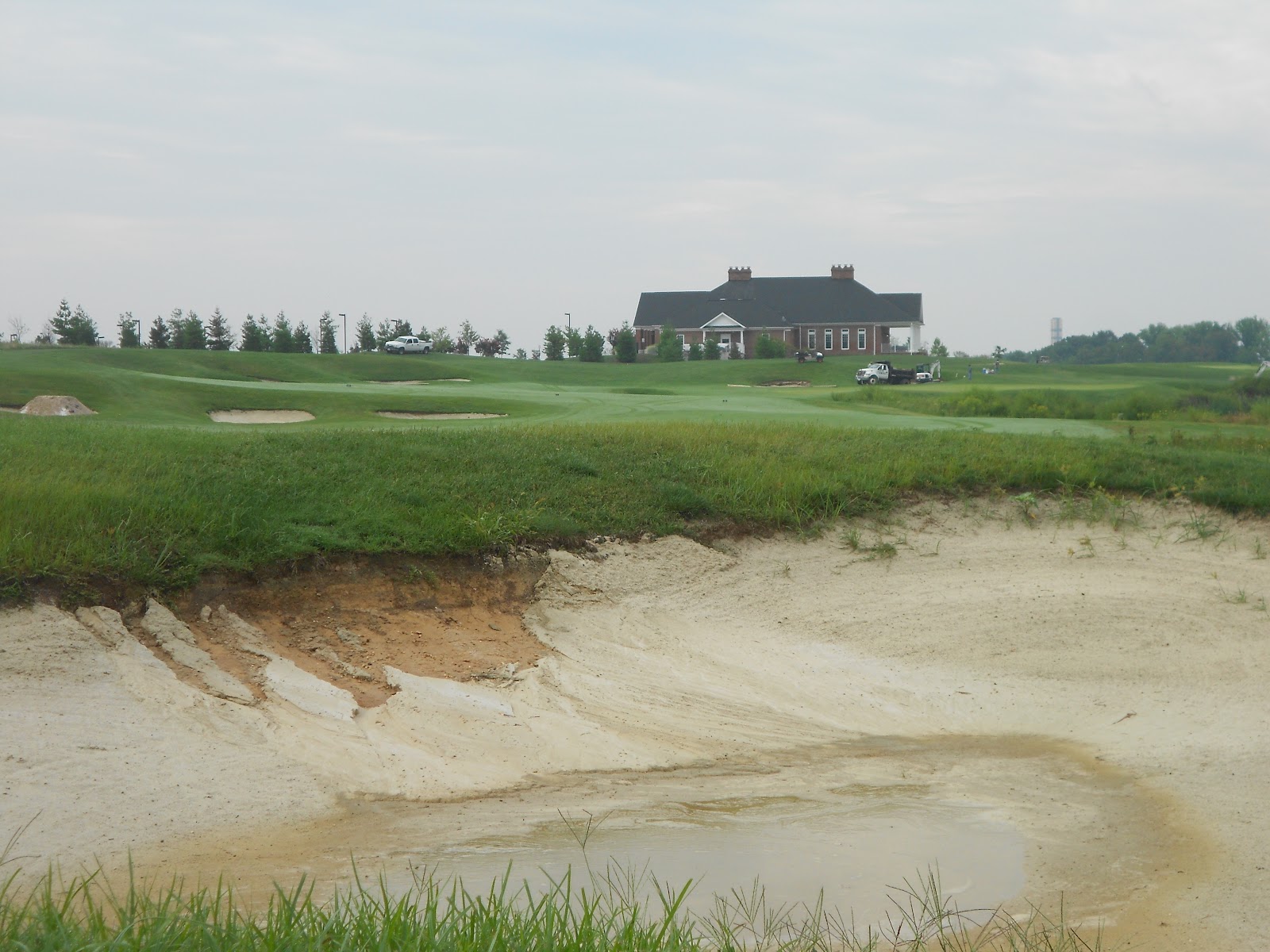
Erosion and contamination problems on existing bunkers

Sand removal and new edge cutting

Clean-up and testing of existing draintile


Gravel installation


Polymer application


Sand installation
 
Finished product


Tuesday, September 11, 2012


LET IT GROW, LET IT GROW, LET IT GROW... 

It's been a hot and heavy month of construction at Chenequa Country Club in Hartland, WI, where Lohmann Golf Designs and Golf Creations have rebuilt the green on #2 and the entire hole #3.  The renovation process actually started way back in 2002 when LGD prepared a master plan for all 18 holes and the driving range, and since then we've been implementing small projects on an every-other-year basis. 

This year' s project on #2 and #3 is probably the most dramatic makeover so far, though.  The greens for each hole sit along a newly constructed pond complete with boulder wall.  The new settings are dramatic, visually stunning, and add considerable strategic options for players to ponder.  Hole #3, a 175-yard par 3, was re-equipped with a new teeing complex situated north of the old tees atop an existing hill.  The new look is spectacular, if not a bit intimidating.  But there is definitely room to maneuver around the hazard and bump your way to the green for those who can't handle the carry.

It's grow-in time now, and with the mild temperatures and low humidity, you can almost see the new turf filling in!


Friday, September 7, 2012

Certification the Right Answer

When something appears too good to be true, there’s a good chance it’s not true! That's the reality when bidding construction jobs. We saw a supreme example of this a few years back up in Grand Rapids, Mich., at Fifth Third Ballpark, home to the Tiger’s Single-A affiliate, the Whitecaps. The owners there spent $400,000 with our company in 2009 to completely rebuild a field that was only a year old! The culprit? Cheap pipe that was never tested.

There’s a standard of materials and workmanship to which golf course builders are religously held, and the reality is, that standard didn’t really exist in the sports field realm until a few years ago when the The American Sports Builders Association (formerly the US Tennis Court & Track Builders Association) developed a certification process for field builders.  We support those efforts and are in the process of achieving our own certification.

An industry standard for sports field contractors is a great thing. If the school district or park district or municipality has confidence in the certified bidders, they will have confidence in the bids — a confidence that even the low bids will ultimately yield a quality, finished product and that money is being spent wisely.

LSF's field renovation at Fifth Third:


Tuesday, August 28, 2012

College sports seasons underway with the help of Lohmann Sports Fields

It’s nearly September and we all know what that means: The beginning of another fall season on the collegiate sports scene. It also means high visibility for two projects from our team at Lohmann Sports Fields (LSF).


The first is the newly renovated soccer field at the University of Wisconsin in Madison, which hosted the first match on the new field Aug. 18 (that was the opener for both teams; since when do fall sports seasons begin in mid-August?). In any case, Wisconsin (alma mater of LSF founder and principal, Badger Bob Lohmann) defeated Notre Dame, 1-0, and a video report from match — including some sweet, low-angle shots of that beautiful new field — can be seen here.

Notre Dame student-athletes are well familiar with the work of LSF, which reconditioned the soil profile and regrassed the football field at Notre Dame Stadium in 2008, after building the all-new softball field in South Bend the year before.

Notre Dame’s football team opens the season this weekend — in Ireland of all places, against Navy — but the home opener in South Bend is scheduled for Sept. 8 against Purdue. All of Notre Dame’s football games are televised, so think of LSF when you see some tailback cut hard off tackle and maintain sure-footing, thanks to the expertly installed, super healthy turf.

For the record, LSF stripped the entire playing surface using a Koro Field Topmaker, roto-tilling in an assortment of soil amendments, laser-grading the field, then resodding with bluegrass imported from Colorado. Jim Lohmann oversaw that job and did the entire deal in 10 days. He worked side by side with George Toma, famed grounds keeper at several NFL stadia, whom Notre Dame had hired to consult on the project.

We’re proud of LSF’s association with major universities, but LSF gained their business thanks to a diverse list of happy clients, from tiny Marengo High School in suburban Chicago (multi-field complex) to the Dow Diamond in Midland, Mich., home to the Great Lakes Loons, the Single A affiliate of the Los Angeles Dodgers — Ballpark Digest named Dow Diamond its 2007 “New Ballpark of the Year”, and The Midwest League named Dow Diamond its 2007 “Field of the Year”.

After all, no job is too big or small to be done exactly right.

Monday, August 20, 2012

Nothing’s perfect.

At least, very few things start out that way. Take all these “grow the game” initiatives many of golf’s governing bodies have undertaken. Most start with the best of intentions but require significant tweaks to get the job done.  Oftentimes, those adjustments are really just a more effective pooling of resources, as most worthwhile things have lots of moving parts.

Our fearless leader, Bob Lohmann, wrote this week at golfcourseindustry.com about several initiatives that have really come into their own thanks to this sort of cooperation. One involves the First Links program, a worthy collaboration of the PGA of America and the American Society of Golf CourseArchitects, whereby the PGA put up $50,000 in grant money to cover the initial expenses for ASGCA members to consult with golf facilities seeking to build a learning facility for beginning or otherwise novice golfers.

Course facilities apply for these grants and an ASGCA member is sent out to approved-applicant courses to assess the site for game-growing opportunities. One of the grant recipients, Elliot GCin Rockford, Ill., chose Lohmann Golf Designs to handle consultation to one approved course project this summer. We’re just back from Rockford, where we provided some serious, much-needed planning and design services, including a detailed costing out of eventual construction.

Yet the First Links effort offers no financial mechanism to move a project like Elliot GC’s from planning to construction, and from the completion of construction to operations and maintenance.

Enter Leon McNair from Links Across America — part of The Wadsworth Golf Charities Foundation (WGCF), the philanthropic arm of Wadsworth Golf Construction — which provides that mechanism, that bridge to construction and day-to-day operations that these “grow the game” facilities need.

We’ve gotten to know Leon and LAA quite well in recent years. We love what they do, and one of the things Leon is always talking about is the creation of “real” golfers — players who don’t just know how to swing the club but how to handle themselves on the course, how to enjoy themselves, how to be good playing partners. Lots of us had dads or other mentors who taught us this stuff, but lots of us don’t have that resource.

It strikes us here that pooling resources to give kids or otherwise new players that sort of support is analogous to what we’re all doing at Eliot GC — the PGA, the ASGCA, LAA and LGD, among others. It takes a village to make golfers, and golf courses.

Thursday, August 16, 2012

Hot gassing underway

Methyl bromide hot gassing is underway at Indian Creek.  This is actually phase 3 of a 27-hole gassing and re-grassing program.  Interstingly, the owner's purchased their methyl bromide for all three phases back in 2010 when it seemed inevitable that the new label would limit the use of the product into the future, and the supplies under the old label would last only a season or two.  

Not sure where they are at now with the labeling and supply, but we are sure that the gassing and re-grassing process pays huge dividends.  Like much of the Midwest, the Omaha area has suffered drought and high heat this summer, which wreaks havoc on poa annua roots.  But the new greens at Indian Creek (phase 1 and 2, the latter of which opened this spring) now sport pure stands of A-1/A-4 blend and are holding up tremendously well against this severe summer stress.

Fumigation underway

Drought stress evident in fairways and roughs, but new greens holding up well.
  

Wednesday, August 15, 2012

Realizing a long-range vision at Chenequa CC

Lohmann Companies is hard at work renovating the 2nd and 3rd holes at Chenequa CC in Hartland, WI.  Proposed as part of a long-range master plan prepared in 2002 by Lohmann Golf Designs, the project includes the construction of a new pond, complete with stone retaining wall, and the relocation of the 2nd and 3rd greens along the water's edge.  

Hole 2, a drive-able par 4, will also see the reconstruction of its fairway bunkers to add a more strategic element on the tee shot.  That, along with the new green hanging dangerously close to the water along its back edge, will give CCC members a lot more to think about when determining their playing approach on this short, but demanding hole.  Here's a look at LGD's computer rendering of the proposed green, before and after:

Hole 2 Green - Existing

Hole 2 Green - Proposed
Hole 3, an existing par 3, will essentially be a new golf hole that will play from 120 to 175 yards over the pond to a green guarded on its back and sides by new mounding and existing ravines.  The new teeing area is located along a hillside located due north of the existing tees, and offers spectacular views of this intimidating hole.  See below a before view of the new hole corridor (notice the existing green behind the trees), followed by an after view of the new hole.  These images were instrumental in getting the project approved by the members:


Hole 3 - Before from new teeing area

Hole 3 - Proposed
All of the construction work at Chenequa is being completed by Golf Creations, the golf course construction division of Lohmann Companies.  Grassing is scheduled to start in the next couple of weeks.  In the meantime, stay tuned for updates on construction and photos of our progress.